Lymphatic vs. Glymphatic
While both systems are responsible for clearing waste and maintaining fluid balance, they operate in different territories and under different biological rules.
The Lymphatic System
The Lymphatic System is a body-wide network of vessels, nodes, and organs. It acts as a secondary circulatory system that handles fluids that leak out of your blood vessels.
- Primary Fluid: Lymph (interstitial fluid, proteins, and fats).
- Key Components: Lymph nodes, spleen, thymus, and tonsils.
- Pumping Mechanism: Unlike the heart, it has no central pump. It relies on skeletal muscle movement, breathing, and one-way valves to move fluid.
- Primary Function: Immune surveillance, fat absorption from the gut, and maintaining fluid pressure in tissues.
The Glymphatic System
The Glymphatic System is a functional waste clearance pathway for the Central Nervous System (CNS). The "G" stands for Glia, the support cells of the brain that facilitate this process.
- Primary Fluid: Cerebrospinal Fluid (CSF) and Interstitial Fluid (ISF).
- Key Components: Perivascular spaces and Astrocytes (specifically the Aquaporin-4 water channels).
- Pumping Mechanism: Driven by arterial pulsation and the expansion/contraction of the brain's extracellular space during sleep.
- Primary Function: Clearing neurotoxic metabolic byproducts, specifically amyloid-beta and tau proteins.
Comparison
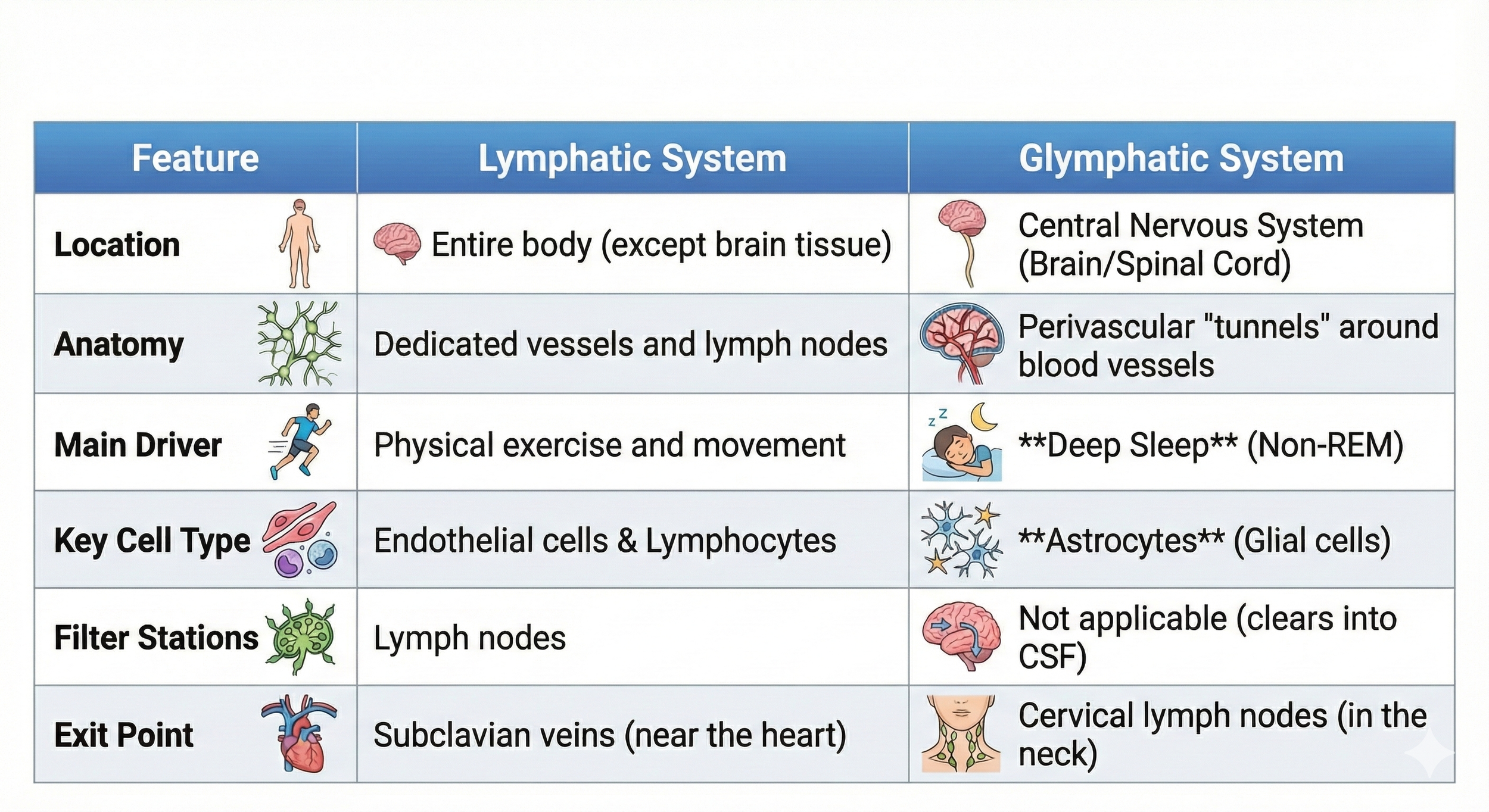
How They Work Together
The two systems are not independent; they are connected in a "relay race" to get toxins out of your head and out of your body.
- The Brain Flush: During deep sleep, the glymphatic system opens up. CSF rushes into the brain tissue, "washing" the metabolic waste away from neurons.
- The Transfer: This waste-filled fluid drains out of the brain via the meningeal lymphatic vessels—tiny channels located in the lining of the skull.
- The Hand-off: These vessels lead directly to the Cervical Lymph Nodes in your neck.
- The Final Disposal: Once the brain's waste enters the cervical lymph nodes, it is officially in the Peripheral Lymphatic System. It is then filtered and eventually dumped back into the blood to be excreted by the liver and kidneys.
Without a functional Glymphatic system, toxins build up in the brain (linked to Alzheimer's). Without a functional Lymphatic system, those toxins have nowhere to go once they leave the brain, causing a "backlog" of waste in the neck.
Lympure System.
A flow- based system to support clarity, detox, and lymphatic rhythm.
The Lympure System is a science-informed, wellness-based approach that gently supports the body’s natural detoxification and
internal flow.
Rooted in the principles of lymphatic and glymphatic health, it promotes circulation, reduces stagnation, and helps restore the body’s deeper rhythms.
It aims to support balance, vitality, and mental clarity—helping you feel lighter, clearer, and more aligned from within.
For those experiencing fatigue, puffiness, or a sense of heaviness,
Lympure offers a gentle return to your natural flow.
The Glymphatic System:
Neurotoxic waste, including β-amyloid, gradually accumulates in the brain. The glymphatic system activates during sleep to clear these toxins—helping reduce the risk of neurodegenerative diseases.
How the Brain Clears Waste During Sleep.
Introduction
While the lymphatic system serves as the body’s waste removal and immune network, the brain relies on a distinct yet parallel system: the glymphatic system.
Discovered in the last decade, the glymphatic pathway plays a vital role in clearing neurotoxic waste and distributing nutrients—particularly during deep sleep.
Understanding this system sheds light on the connection between sleep, brain health, and long-term neurological function.
⸻
Mechanism of Action
1. Waste Clearance
During wakefulness, the brain accumulates metabolic waste, including neurotoxic proteins such as β-amyloid. The glymphatic system removes these substances during sleep, reducing the risk of neurodegeneration.
2. CSF–ISF Exchange
The glymphatic system operates via a convective exchange of cerebrospinal fluid (CSF) and interstitial fluid (ISF) along perivascular spaces. This flow carries waste products toward the brain’s venous system for clearance.
3. Perivascular Pathways
Perivascular spaces—fluid-filled channels that surround cerebral blood vessels—serve as conduits for glymphatic flow, facilitating efficient waste movement.
4. Role of Aquaporin-4 (AQP4)
AQP4 water channels, located on astrocytic endfeet, are essential in regulating fluid exchange. Deficiency or mislocalization of AQP4 has been linked to impaired glymphatic function and increased neuroinflammation.
5. Sleep-Dependent Activity
The glymphatic system is most active during slow-wave sleep, a stage of deep, restorative rest. During this phase, the interstitial space expands by up to 60%, enabling greater CSF influx and waste removal.
⸻
Clinical Implications
Impairment of glymphatic clearance has been associated with several neurodegenerative diseases, including:
• Alzheimer’s disease
• Parkinson’s disease
• Traumatic brain injury
In addition to waste clearance, the glymphatic system is involved in nutrient transport, supporting delivery of glucose, lipids, amino acids, and neurotransmitters.
⸻
Regulation by Circadian Rhythms
Glymphatic activity follows a circadian pattern, increasing during sleep and declining during wakefulness. Disrupted sleep cycles—due to stress, aging, or irregular schedules—may diminish glymphatic function over time.
⸻
Conclusion
The glymphatic system represents a critical physiological process for maintaining brain homeostasis.
Adequate sleep, hydration, and healthy circulation are key factors that support glymphatic function and may contribute to long-term brain resilience.
⸻
Call to Action
To support glymphatic health:
• Prioritize consistent, high-quality sleep
• Stay well-hydrated
• Incorporate light movement and circulation-enhancing practices into your routine
Improving your body’s internal flow may be one of the most effective steps toward long-term cognitive vitality.
⸻
*To learn more about how the glymphatic system works and why it matters, explore the research below.
References
1. Iliff, J. J., et al. (2012). A paravascular pathway facilitates CSF flow through the brain parenchyma and the clearance of interstitial solutes, including amyloid β. Science Translational Medicine, 4(147), 147ra111. https://doi.org/10.1126/scitranslmed.3003748
2. Nedergaard, M., & Goldman, S. A. (2020). Glymphatic failure as a final common pathway to dementia. Science, 370(6512), 50–56. https://doi.org/10.1126/science.aaz5599
3. Xie, L., et al. (2013). Sleep drives metabolite clearance from the adult brain. Science, 342(6156), 373–377. https://doi.org/10.1126/science.1241224
4. Mestre, H., et al. (2020). The brain’s glymphatic system: Current controversies. Trends in Neurosciences, 43(7), 458–466. https://doi.org/10.1016/j.tins.2020.04.003
Lymph Nodes:
An essential guide to understanding lymph nodes, their function, and what swollen nodes may be telling you about your health.
Essential Structures in Immune Defense.
Overview
Lymph nodes are small, bean-shaped structures that are part of the lymphatic system, playing a critical role in the body’s immune defense.
They filter lymph fluid, trap bacteria and viruses, and contain white blood cells (lymphocytes) that respond to infections and abnormal cells.
Lymph nodes are distributed throughout the body, with high concentrations in areas such as the neck, armpits, groin, behind the ears, chest, and abdomen.
⸻
Primary Functions
1. Filtration of Lymph
Lymph nodes act as biological filters, removing bacteria, cellular debris, and potentially cancerous cells as lymph circulates through the body.
2. Activation of Immune Response
Each node houses lymphocytes—B cells and T cells—that identify pathogens and initiate an immune response.
3. Immune Surveillance and Defense
Lymph nodes serve as monitoring and coordination hubs where immune cells gather to respond to infections and prevent disease spread.
⸻
Anatomical Locations
While lymph nodes are found throughout the body, they tend to cluster in strategic regions near major blood vessels:
• Cervical nodes (neck)
• Axillary nodes (armpits)
• Inguinal nodes (groin)
• Postauricular nodes (behind the ears)
• Thoracic nodes (chest)
• Abdominal nodes (abdomen)
These clusters help regulate lymph flow and immune response in specific regions.
⸻
Swollen Lymph Nodes (Lymphadenopathy)
Lymphadenopathy refers to abnormal enlargement of lymph nodes, which can result from various causes.
Infections
• Viral: colds, influenza
• Bacterial: strep throat, skin infections
During infection, lymphocyte production increases, causing the nodes to enlarge and become tender.
Inflammatory Conditions
• Autoimmune diseases (e.g., lupus, rheumatoid arthritis)
• Chronic inflammation
Malignancy
• Lymphoma, leukemia, or metastatic cancer may cause painless, persistent lymph node swelling.
Other Causes
• Certain medications (e.g., anticonvulsants, antibiotics)
• Trauma or recent surgery
• Temporary swelling after vaccination (e.g., COVID-19 or flu vaccines)
⸻
Clinical Considerations
• Lymph nodes that remain enlarged for more than 1–2 weeks, are non-tender and hard, or are accompanied by systemic symptoms should be medically evaluated.
• Generalized lymphadenopathy (swelling in multiple areas) may indicate a systemic condition requiring further investigation.
⸻
Conclusion
Lymph nodes are a vital part of the immune surveillance and defense network, supporting the body’s ability to detect and eliminate threats.
Changes in lymph node size, texture, or tenderness can signal a range of conditions, from benign infections to serious disease, and should not be overlooked.
⸻
*To learn more about how the glymphatic system works and why it matters, explore the research below.
References
1. Abbas, A. K., Lichtman, A. H., & Pillai, S. (2023). Cellular and Molecular Immunology (11th ed.). Elsevier.
A comprehensive immunology text covering lymph node function, lymphocyte activation, and immune response mechanisms.
2. Moore, K. L., Dalley, A. F., & Agur, A. M. R. (2022). Clinically Oriented Anatomy (9th ed.). Wolters Kluwer.
Anatomical reference for the lymphatic system, including key lymph node groupings and drainage regions.
3. Ferrer, R. (1998). Lymphadenopathy: Differential diagnosis and evaluation. American Family Physician, 58(6), 1313–1320.
A widely cited article outlining causes, clinical approach, and evaluation of swollen lymph nodes.
4. Jameson, J. L., Fauci, A. S., Kasper, D. L., et al. (2018). Harrison’s Principles of Internal Medicine (20th ed.). McGraw-Hill Education.
Medical reference covering systemic diseases involving lymph nodes, including malignancies and autoimmune conditions.
5. National Cancer Institute. (2023). Lymph nodes and cancer.
Overview of how cancer spreads to lymph nodes and how they are used in diagnosis and staging.